Background
When COVID vaccines were first available in early 2021, they were impossible to find.
People scoured pharmacy websites, vaccine hunter groups popped up, and lone techies built vaccine finder sites overnight. The White House sought to address these ad hoc efforts with an official website that let the public search for COVID vaccination locations across the country. The idea was that people could enter their zip code and see locations near them that had COVID vaccines.
I was the first designer on a U.S. Digital Service (USDS) team that was brought in to make that new government site happen. We relaunched an existing CDC site (vaccinefinder.org) as vaccines.gov. Our task was to ensure it could withstand 100 million visitors and make it usable for everyone. The President was going to unveil the site in one month in a national address.
My role
My role was to do a UX audit of the existing site and make strategic improvements that made vaccines.gov accessible and usable for everyone.
I also ended up wearing a product manager hat at time throughout the project. I coordinated translation resources from multiple agencies to translate the site into Spanish and managed efforts to get appointment availability data from the pharmacies.
Auditing the existing site
We scrutinized the current site through usability testing, stakeholder interviews, and heuristic analysis. We wanted to understand where it met the public's needs and where it fell short.
- Usability testing. I organized and facilitated 9 usability sessions that asked participants to use the existing site to find a vaccine near them. We heard and saw peoples' frustrations finding vaccines, what they considered when searching, and where the existing UI caused confusion.
- Stakeholder interviews. We talked to stakeholders across the CDC to understand the goals and constraints that shaped the current site. We also spoke with the national pharmacies and local clinics to learn how the site was getting data and the challenges in delivering that data.
- Heuristic analysis. Another USDS designer and I scored the current site according to a simple rubric of UX, inclusivity, and accessibility heuristics that we created. For example, the site needed to use plain language and be available in other languages or, at least, easily translated.
Before the audit
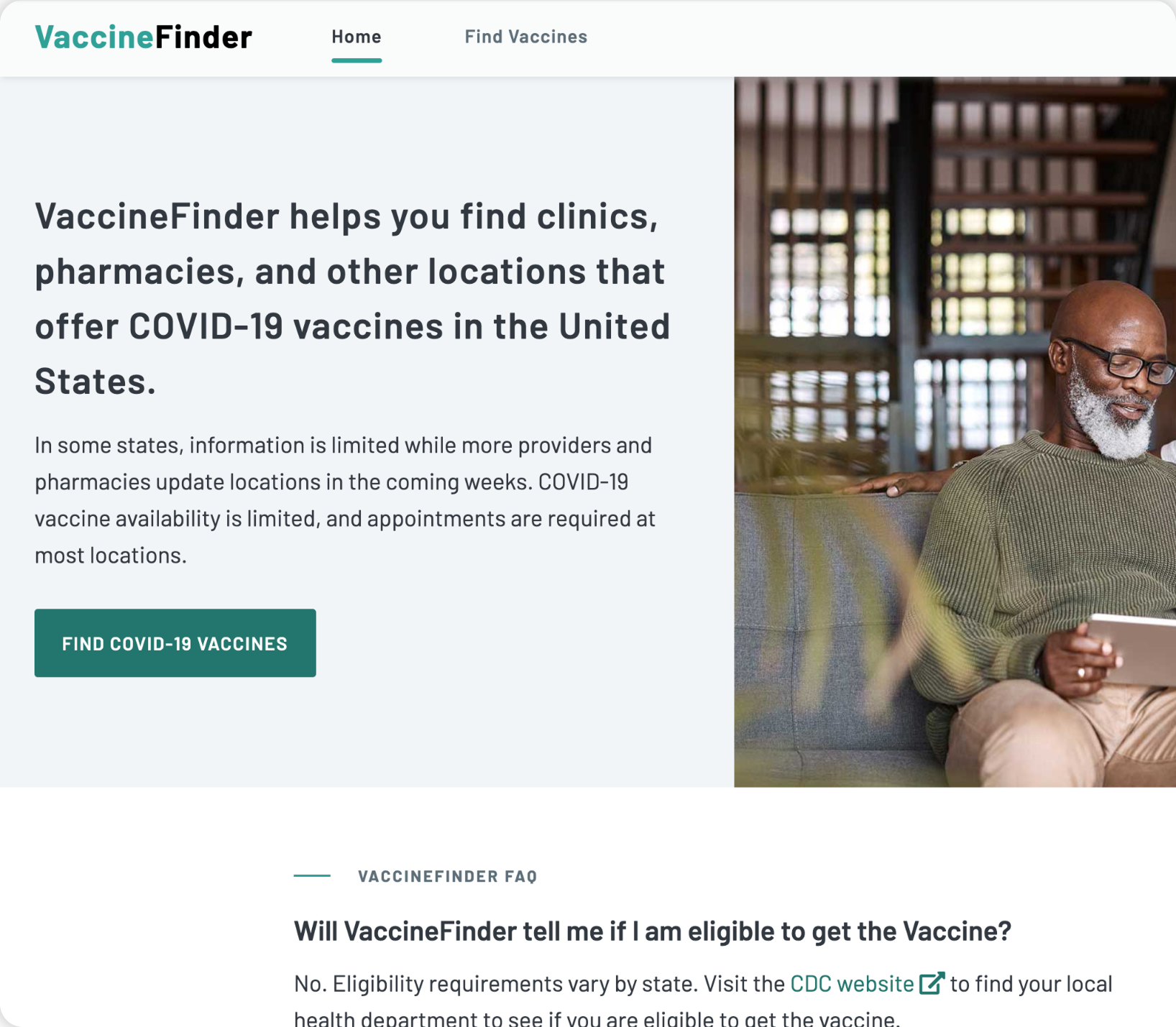
Home page. Site only in English. Way too much text before the CTA.
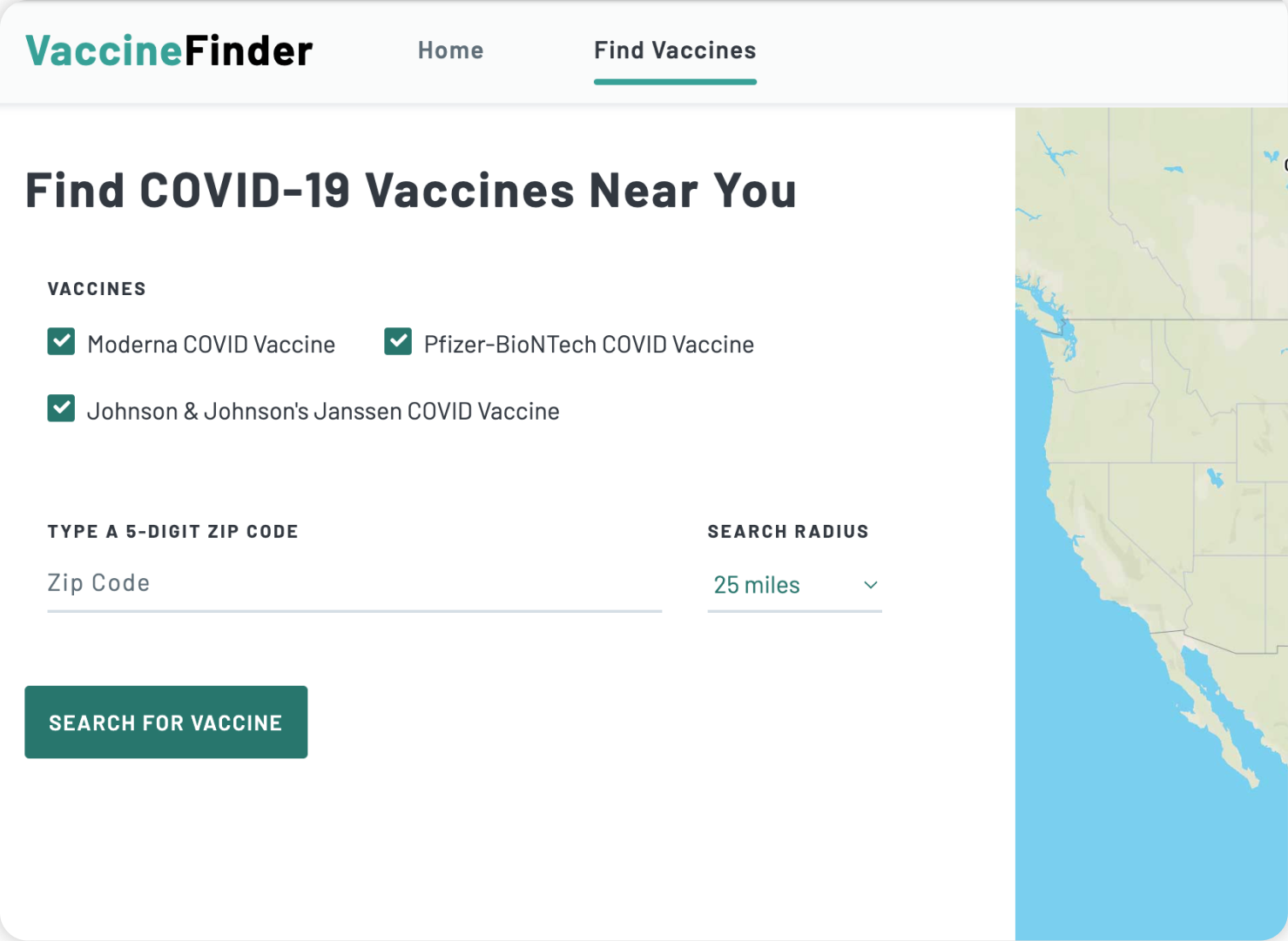
Search. Vaccine filter and zip code search in wrong order for users. Loading the map slowed the site. On mobile, we were loading the map but not actually showing it in the UI.
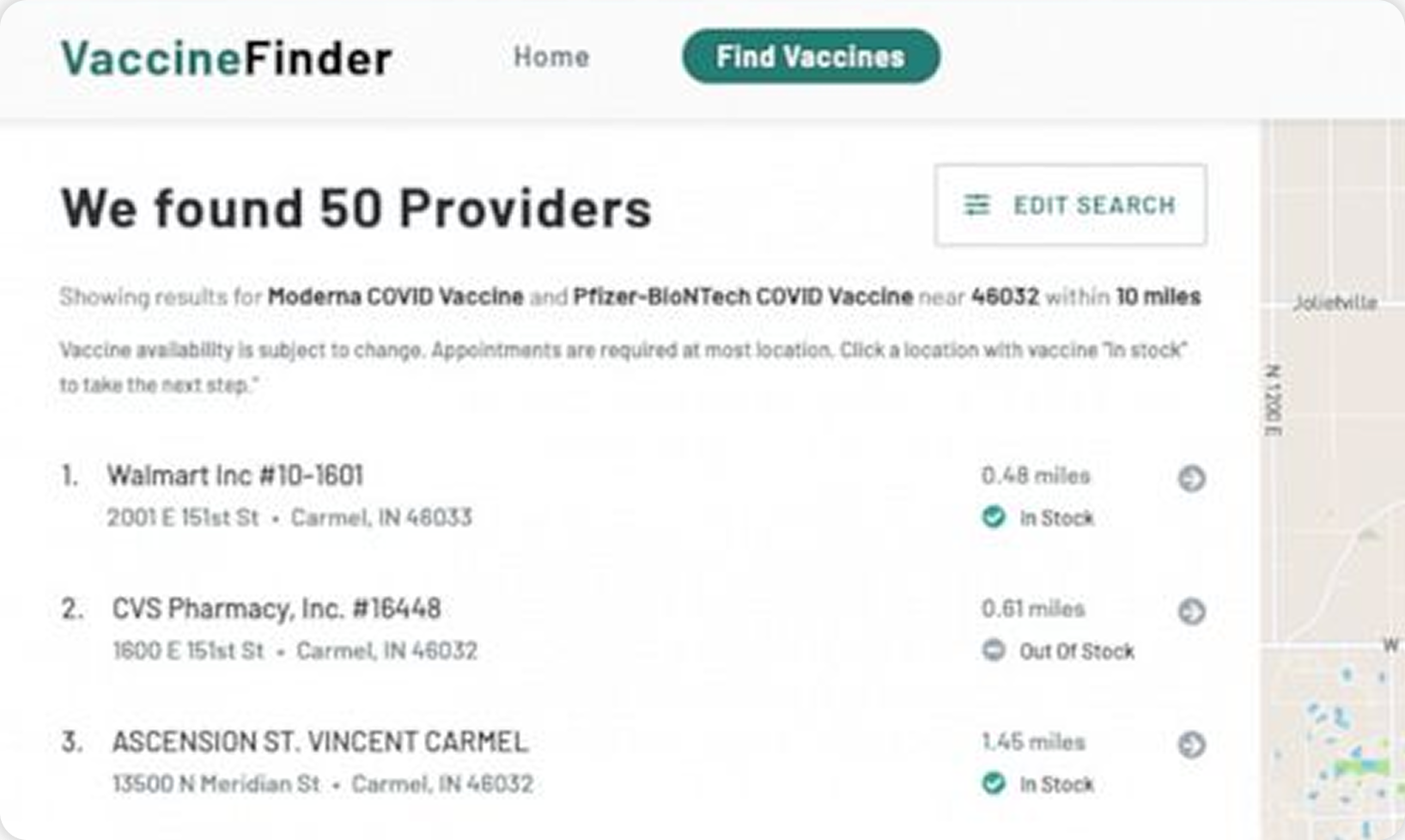
Results. Important details about the active search minimized. Not clear to some in usability that results were clickable. Stock was important to users but disconnected from location name. Some missed this critical info in usability.
After the audit
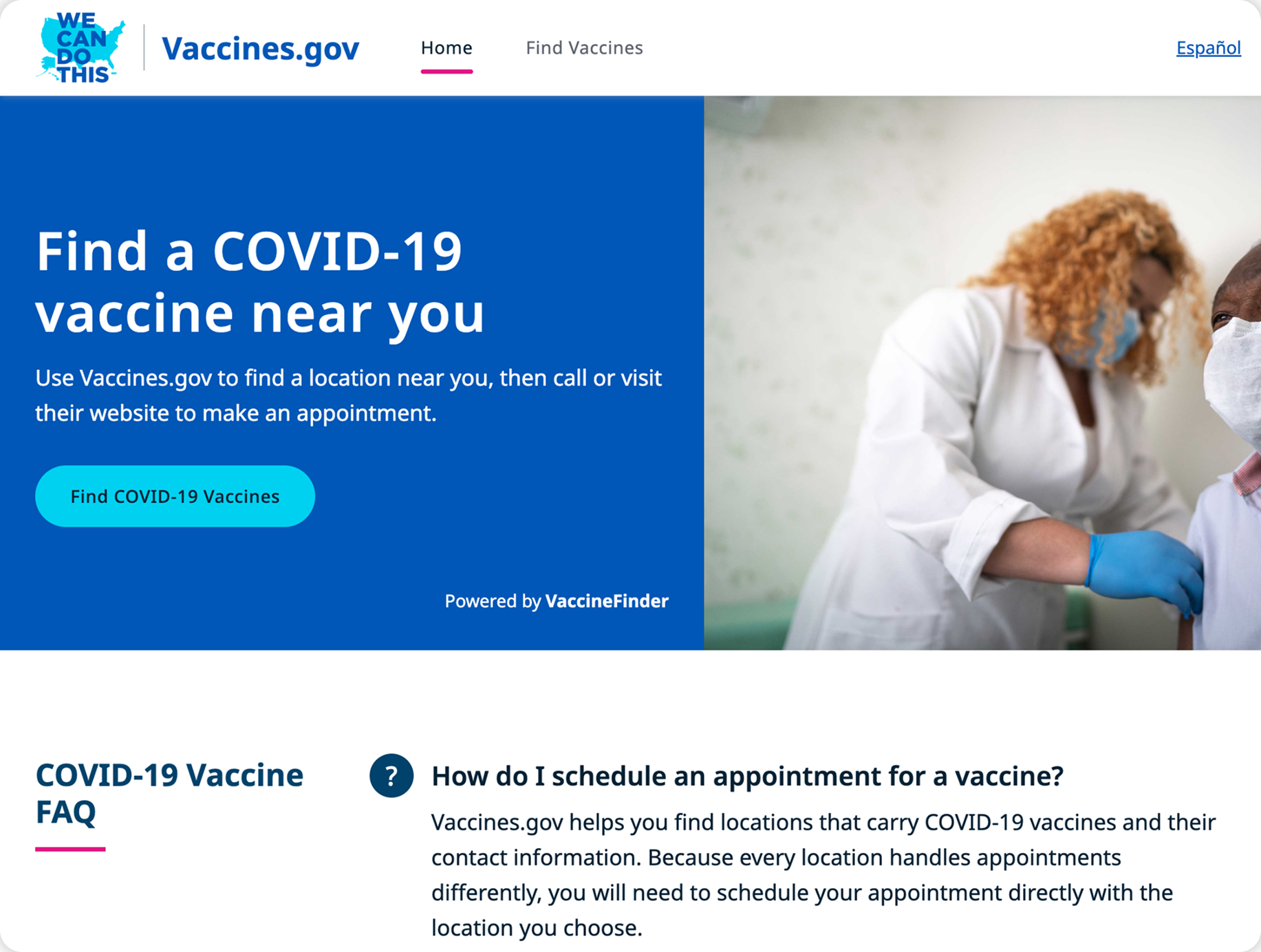
Landing page. Added a Spanish version of the site: vacunas.gov. Clearer messaging with less noise crowding out CTA.
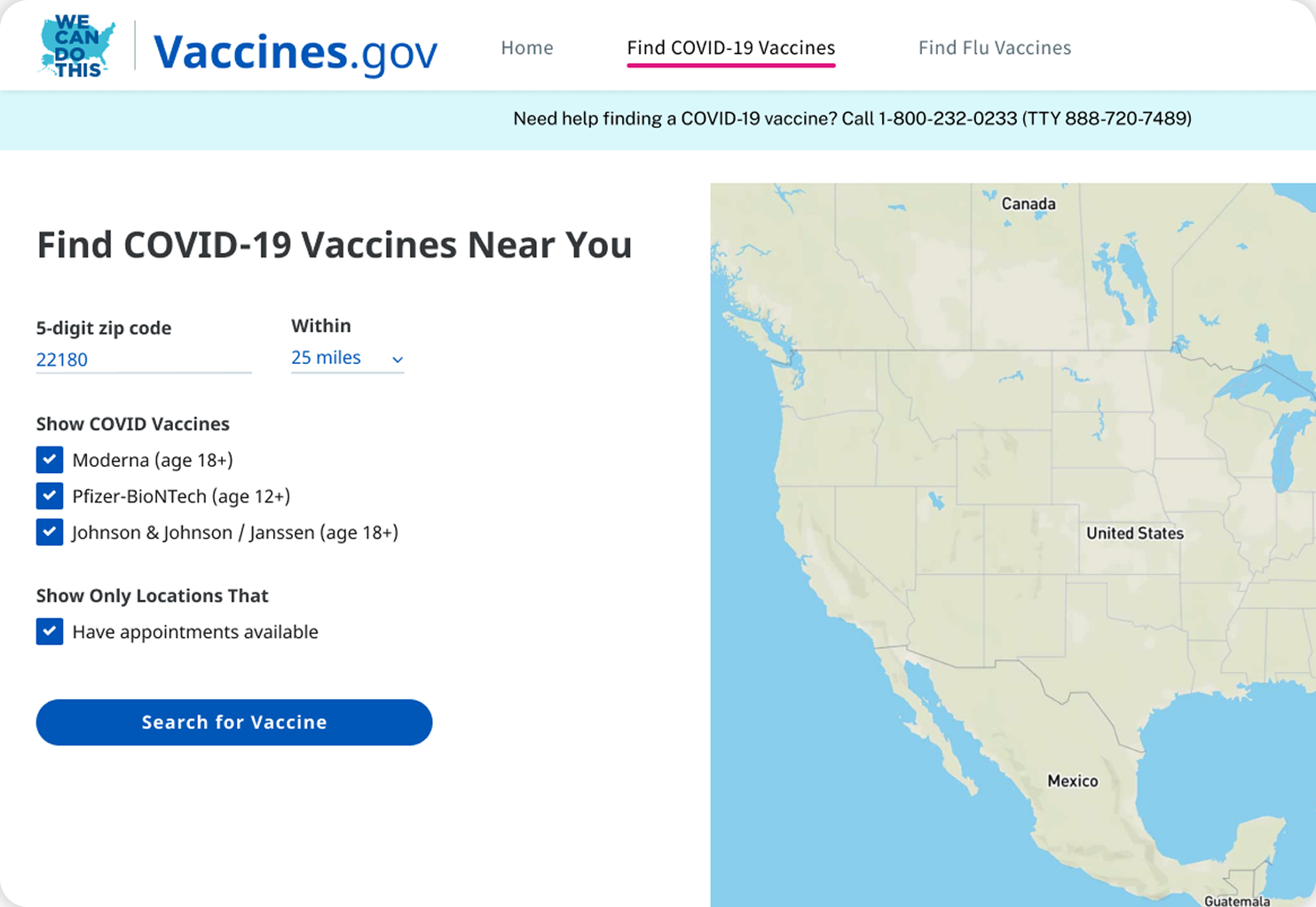
Search. Reorganize search fields and filters to sync with user needs and expectations. Design and engineering optimized map loading without degrading UX. Resulted in much faster load times especially, especially on slow 3G.
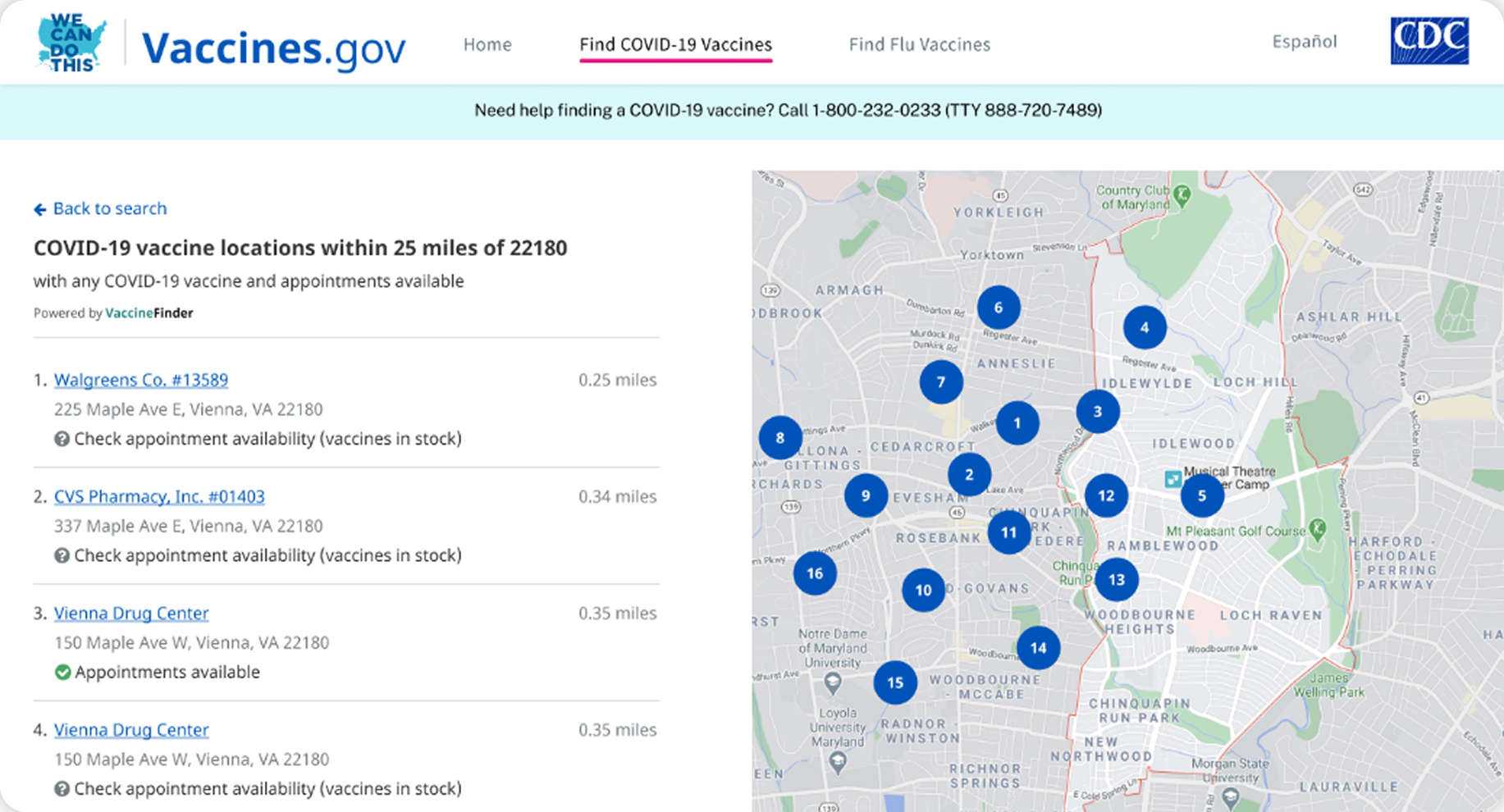
Results. Simplified search details, letting us bring the results higher up the page. Hyperlinked location name to make it clearer that results were clickable. Moved important information about stock/appointment availability under location name and address to allow for easier scanning.
Designing for everyone
We were not building for a specific segment. We needed the site to work for young, old, urban, suburban, rural, English-speaking, non-English speaking, and so on
- WCAG 2.1 AA and more. The team collaborated to make vaccines.gov accessible to those using assistive technology. We audits of color contrast, font size, text readability, and more to bring us in compliance with WCAG 2.1 AA. Going further, I did independent run-throughs of the site using Apple VoiceOver to better understand firsthand how the site would work with assistive tech. We followed our audits with early access of the site to disability advocacy groups. The result was broader access for people with disabilities.
- Vacunas.gov. We created vacunas.gov to make the site accessible to the Spanish-speaking public. I led the effort to get the site content translated into Spanish for the initial launch of vacunas.gov. I worked with engineers and CDC, HHS, and USDS translators to ensure that we were able to create a code infrastructure that allowed for easy updates. We also updated existing design patterns to better accommodate longer text often found in Spanish. This work opened the site up to ~15% of the U.S. population.
- Nearly 50% faster load time on 3G networks. I worked with engineers to make changes that improved the performance of the site. We were smarter about when to load certain large assets, like an interactive map. I ran a "font diet" to cut the variety of fonts and font weights used on the site, which reduced the assets to load. We optimized the images on the site. That work led to a drop from a 10-15 second load time to 7 seconds on slow 3G connections. Not ideal but a marked improvement with a big impact on rural communities without high-speed data.
Appointment availability
The purpose of the site was not to merely tell people where there were vaccines. It was to get people vaccinated.
The existing site told users which locations near them had COVID vaccines. It did not tell them if they could actually get an appointment to get vaccinated. We identified early on that this was a fundamental problem.
We worked with the pharmacies to get data directly from their scheduling systems that would let vaccines.gov show people where they could actually get an appointment to get a vaccine.
I organized and led several meetings with tech and product representatives from all of the pharmacies. I provided rough prototypes for how we might use the data and reported back usability findings on how such hypothetical data would improve the experience, and success, of the site. These prototypes and research were instrumental in creating a narrative for how the site should look and work, ultimately convincing the pharmacies that it was worth their time and effort to open up that data.
The result was 80% of the locations on vaccines.gov had appointment availability data updated daily. As an added bonus, our engineering team worked with the pharmacies to create new open data standard for this kind of appointment data.
Product launch and impact
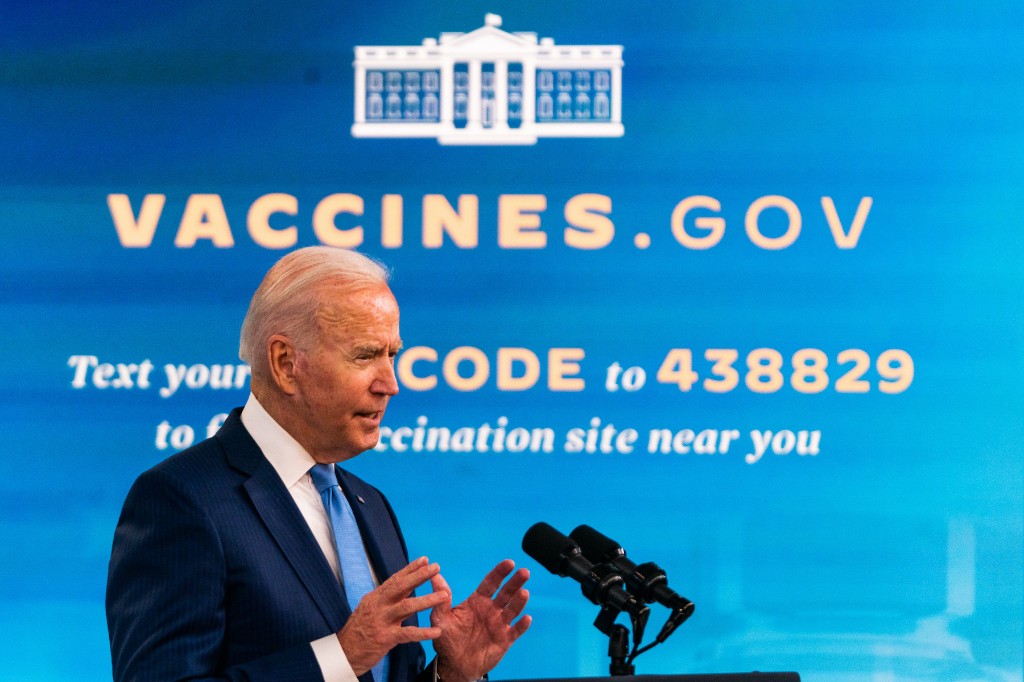
On May 4, 2021, President Biden announced the launch of vaccines.gov and vacunas.gov. The site was very well received by the public. Vaccines.gov and vacunas.gov have helped 184+ million visitors search for COVID vaccines for themselves, friends, and family.